About this research: Findings draw on DiligenceVault’s 2025–26 Global Manager Survey, capturing insights from 780+ asset managers and GPs across 78 countries, and DiligenceVault’s IR Roundtable series, which brought together IR and RFP/DDQ professionals from firms ranging from $100M to $500B in AUM.
Today, more than 35 solutions are available to help asset managers automate RFPs and DDQs. Yet despite this, many IR teams still describe the diligence process as one of the most operationally intensive parts of fundraising and investor reporting.
The reason is straightforward: most solutions address only one part of the problem. The real challenge is managing investor diligence data across the entire lifecycle, from maintaining a structured, always-current knowledge base to handling the custom 300-question DDQ that lands on a Tuesday with a Friday deadline.
KEY DATA FROM THE 2025–26 GLOBAL MANAGER SURVEY
- 70% of asset managers still manage RFP and DDQ content libraries through shared folders such as SharePoint and OneDrive
- Standard DDQ acceptance has grown 46% over three years, from 26% in 2023 to 38% in 2025
- 40% of respondents reported receiving longer DDQs year over year
- 50% reported growth in AI and cybersecurity-specific questionnaires
- More than 30% of firms across all AUM tiers are actively using AI tools, and firms under $10bn are moving as fast as $100bn+ counterparts
- 14% of allocators are now asking managers to disclose their use of AI in DDQ responses
WHY DILIGENCE HAS GOTTEN HARDER
Institutional investors today expect transparency across strategy and performance, operations and governance, risk management, sustainability, and increasingly, a firm’s AI policy and cybersecurity posture. Entirely new diligence categories, particularly AI governance and cybersecurity, have emerged in just the last five years.
The infrastructure supporting these workflows has not kept pace. 70% of asset managers still rely on shared folders as their primary content library.
Key information lives across spreadsheets, email threads, and disconnected systems, and when a new questionnaire arrives, teams assemble responses manually from whatever they can find.
The result is duplicated work, inconsistent disclosures, and significant time lost searching rather than updating.
We call this accumulated inefficiency digital debt. Moving from digital debt to velocity, responding at scale without proportionally increasing headcount, is the defining infrastructure challenge for IR teams in 2026.
WHERE AI IS – AND ISN’T – WORKING
More than 30% of firms across all AUM tiers are actively using AI today. Common use cases include meeting preparation, investor research, drafting, and document queries. AI has become an equalizer; smaller firms are adopting it just as quickly as larger ones.
But adoption is outpacing governance. Many teams have not fully addressed the risks of uploading confidential fund data into third-party tools. Allocators are beginning to take notice: 14% now request disclosure of AI usage in DDQ responses, and some have asked firms not to use AI at all.
There is also an operational learning curve. In early deployments, AI-generated content often required significant correction at senior levels, in some cases, increasing rather than reducing workload.
The firms navigating this well share a common trait: AI is deployed alongside governance frameworks, structured review processes, and a clear understanding of where it can fail.
THE RFP & DDQ VENDOR LANDSCAPE
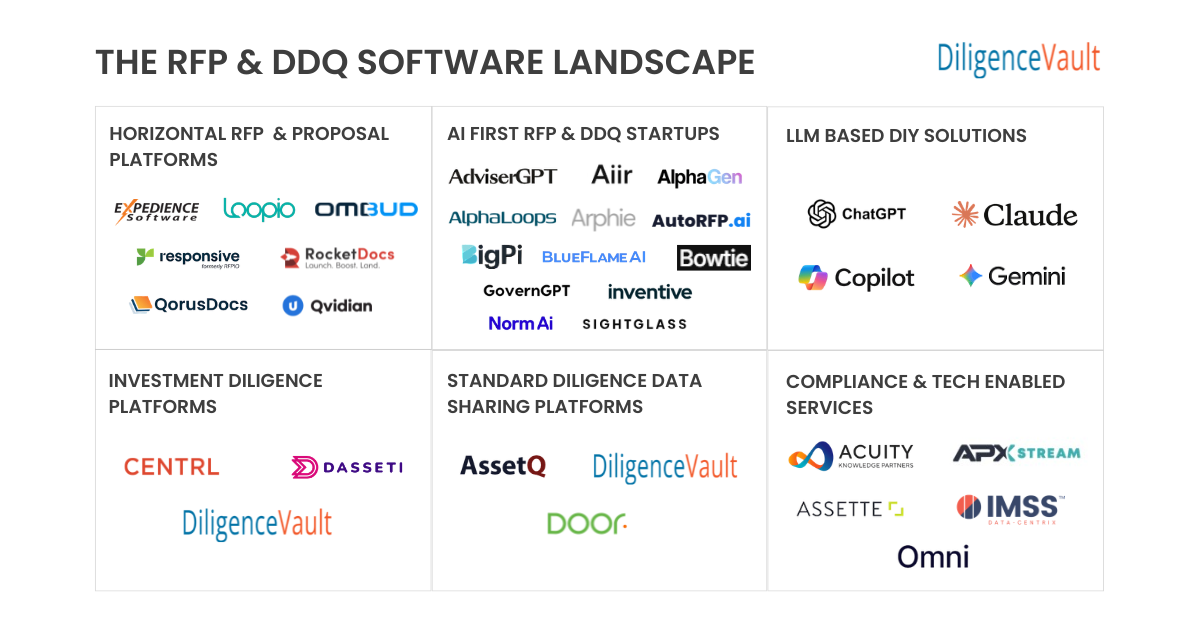
Six solution categories define the market today.
Category 1: Horizontal RFP & Proposal Platforms
Originally built for enterprise sales teams, these platforms are mature and designed around content libraries, workflow management, and document collaboration. Most have added AI-assisted drafting capabilities in recent years.
Vendors: Expedience, Loopio, Ombud, QorusDocs, Qvidian, Responsive, RocketDocs
Core capabilities: Centralized answer libraries, workflow management, document collaboration, SME review and approval, AI-generated responses
Primary ROI driver: Faster content retrieval and more consistent first drafts
Category 2: AI-First RFP & DDQ Startups
These vendors are built around large language models and generate responses from unstructured documents such as past DDQs, fund materials, and policies. AI is the core product rather than an added feature.
Vendors: AdviserGPT, Aiir, AlphaGen, AlphaLoops, Arphie, AutoRFP.ai, BigPi, Blueflame AI, Bowtie, GovernGPT, Inventive AI, Norm AI, Slightglass
Core capabilities: AI-generated responses, document ingestion, automated question matching, knowledge base search
Primary ROI driver: Speed of first draft, with effectiveness dependent on review and governance
Category 3: LLM-Based DIY Solutions
This category reflects direct use of general-purpose AI tools for diligence workflows. Flexible and low-cost to start, but without the structure, governance, or investment-specific context of purpose-built platforms.
Vendors: ChatGPT, Claude, Copilot, Gemini, NotebookLM
Core capabilities: AI-generated responses, summarization, document queries, flexible internal workflows
Primary ROI driver: Low barrier to entry and broad utility
Category 4: Investment Diligence Platforms
These platforms help asset managers manage diligence workflows within structured systems. They combine content libraries, workflow routing, and in some cases, AI and allocator connectivity
Vendors: Centrl, Dasseti, DiligenceVault
Core capabilities: Workflow management, centralized content, SME routing, AI-generated responses, allocator connectivity
Primary ROI driver: Industry specialization and allocator connectivity
Category 5: Standard Diligence Data Sharing Platforms
This represents a fundamentally different architecture. Rather than managing responses, these platforms enable standard diligence data to flow directly between managers and allocators at scale.
Vendors: AssetQ, DiligenceVault (Blaze), Door
Core capabilities: Standard diligence profiles, one-to-many distribution, allocator connectivity, pre-digitized templates
Primary ROI driver: Compounding efficiency, each standardized request served automatically requires no incremental effort
Category 6: Compliance & Tech-Enabled Service Providers
These vendors combine domain expertise with technology to deliver RFP and DDQ workflows as a managed service.
Vendors: Acuity, APX, Assette, IMSS, Omni, Compliance consultants
Core capabilities: Outsourced RFP/DDQ delivery, compliance support, fund marketing database population, managed service
Primary ROI driver: Headcount reduction and risk management through expert-reviewed outputs
DILIGENCEVAULT: ONE DATA PIPELINE
Most RFP and DDQ tools operate on a single data source, either content libraries that grow stale fast or documents such as pitch decks, past DDQs, and fund documents ingested at the point of request. DiligenceVault’s architecture is built around a live, structured data layer that connects three inputs: Blaze Live Profiles, inbound requests from the allocator network, and external RFP/DDQ requests received in Word or Excel.
This unified pipeline supports three workflows without duplication.
- Standard data sharing: Blaze Live Profiles act as an always-on diligence record, updated once and distributed across investors. Managers also have access to 15+ pre-digitized industry standards (AIMA, ILPA, PRI, INREV, ICI)
- Bespoke automation for Word/Excel DDQs and RFPs: AI-generated responses for custom questionnaires, routed through SME review and compliance workflows
- Allocator connectivity: Same solution as for the bespoke requests, but for 100+ allocator clients of DiligenceVault
The distinction is not just in how responses are generated, but in which diligence touchpoints the system addresses, and in what the system is built on, a structured, continuously updated data layer rather than isolated documents.
WHAT COMES NEXT FOR IR INFRASTRUCTURE
The pattern is clear. Firms still managing diligence content through shared folders are absorbing a compounding cost. Each new category, AI governance, cybersecurity, and sustainability, adds to the burden without corresponding infrastructure.
Firms managing this transition effectively share a few traits:
- Content owners review AI outputs before being shared externally
- Source data is curated and version-controlled
- Clear policies exist around how and where AI is used
The near-term shift is not about replacing IR teams. It is about data and workflow readiness.
Firms with structured, current, and consistent diligence data will respond faster, with greater consistency and less rework. Firms still reconciling answers across folders and email will face the same problem, at a greater scale and cost.
Your next mandate won’t be won in a PDF. It will be driven by stronger relationships and higher-quality diligence outputs, both enabled by intelligent automation that frees up human capacity to focus where it matters most.