Over the past few weeks, markets have sent a message that’s hard to ignore.
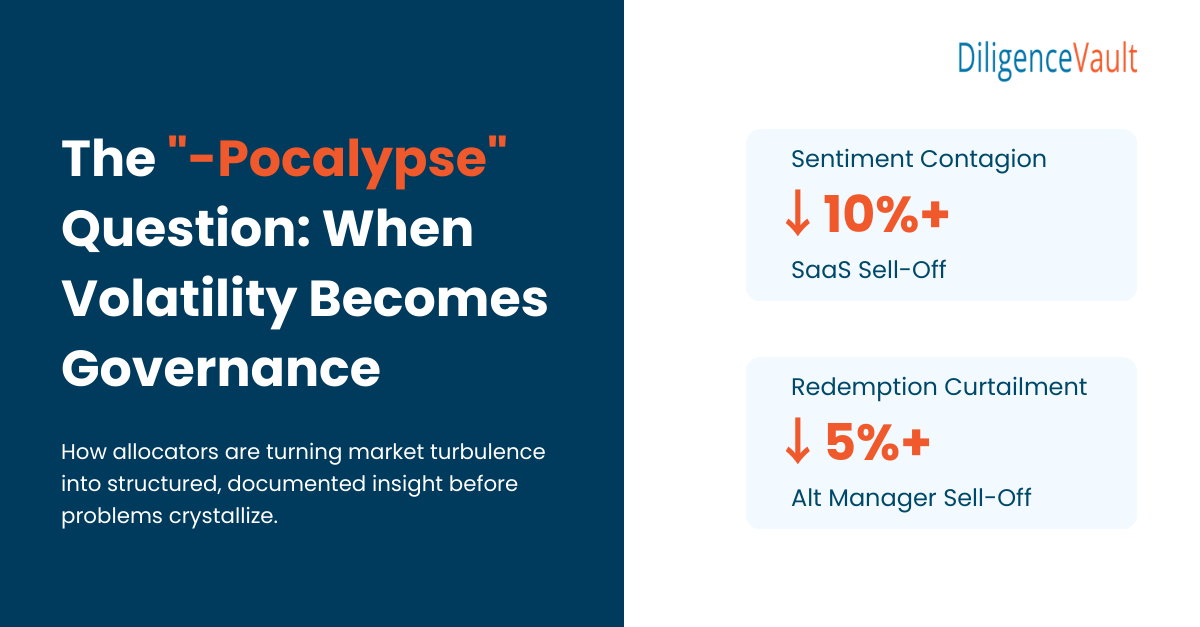
Shares of alternative asset managers such as Blue Owl Capital have plunged sharply, with recent price action down as much as ~10% on heavy selling after the firm curtailed redemptions at one of its private-credit funds, prompting broader pressure across the sector. (FinancialContent)
The reaction rippled through the alternatives ecosystem. Major firms, including Blackstone and Ares Management, saw their stocks slide. Blackstone shares dropped more than 5% on the move, as investors repriced exposure to private credit and liquidity risk. (Benzinga)
At the same time, broader financial and wealth-tech markets have felt the pinch. Software and data providers, historically reliable proxies for growth, have seen downward revisions in multiples, impacting valuation benchmarks used across both public and private portfolios.
For many allocators, this isn’t just noise.
It’s a trigger event, a moment to check exposure and document risk in a systematic way.
Why This Matters
When a large private-credit manager curbs redemptions or sells assets to satisfy liquidity needs, it can affect more than just that firm’s stock price:
- Valuations can shift, especially where private portfolio marks reference public comps.
- Liquidity paths can tighten, altering refinancing and exit assumptions.
- Capital markets sentiment can spill over, impacting SaaS/data businesses that serve fund operations and portfolio companies.
- Portfolio financing structures tied to NAV facilities or leverage may come under stress.
These are not theoretical risks. They’re real, interconnected, and measurable.
Asking the Right Questions
In response, allocators are adopting a simple discipline: rather than wait for problems to crystallize, they ask early, structured questions such as:
- Is your portfolio directly exposed to downtrends in alternative managers, wealth platforms, or SaaS/data providers?
- Are you indirectly affected, for example, through private market NAV marks tied to public multiples, or portfolio companies that sell into these sectors?
- Have you observed secondary effects on liquidity, financing cost, or exit timing?
- Do you have portfolio finance exposure, leverage, facilities, or embedded NAV-linked debt that could be sensitive to repricing events?
- What is the expected NAV impact, and over what time horizon?
- Have you taken risk management actions in response to hedges, de-risking, re-underwriting?
- Are there natural hedges embedded in the portfolio, defensive streams, senior secured positioning, or other offsets that mitigate net exposure?
These are not “gotcha” questions. They are clarity and governance questions, the sort that protect internal stakeholders, from investment committees to auditors, without implying alarm.
Process Over Panic
Volatility itself isn’t the risk.
The risk is opacity.
Allocators with structured assessment practices, whether via internal frameworks or digital tools, are at an advantage. They can turn market moves into documented insight, rather than anecdote.
At DiligenceVault, we see how a simple shift from informal check-ins to targeted event-driven surveys can produce better transparency, better comparability across managers, and better institutional memory. It’s not about reacting to the “-pocalypse.” It’s about responding with rigor.
Clients can access a ready-to-deploy digital survey on DiligenceVault.
For all other users, please download the survey by completing the signup form below.
In volatile markets, the smartest question isn’t whether portfolios feel pressure; it’s how clearly you know why.
Signup below to download the survey PDF.